
 Rackmount PC
 Embedded Computing
 Industrial Portable Computers
 Rugged Tablets
 Rugged Laptop
 Industrial Panel PC
 Rugged Handheld
 Advantech Industrial PC
Dell Rugged Tablet or SINSMART? Rugged Tablet Buying Guide for Industrial Buyers
Table of Contents
- I. Introduction
- II. What Industrial Buyers Really Need from a Rugged Tablet
- III. Dell Rugged Tablet and SINSMART Rugged Tablet: Two Manufacturer Models
- IV. Dell Rugged Tablet vs SINSMART Rugged Tablet: Different Design Philosophies
- V. Rugged Tablet Customization: A Key Difference Buyers Should Understand
- VI. From Rugged Tablet to Rugged Laptop: Thinking Long-Term with the Right Manufacturer
- VII. Buying Guide: How to Evaluate Dell Rugged Tablet and SINSMART
- VIII. Rugged Tablet Comparison: How You Should Read the Specs—Not the Brand
- IX. Recommended SINSMART Rugged Tablet Options by Application
- X. Why Choose SINSMART Rugged Tablets?
- XI. Conclusion
- XII. FAQs
Introduction
Field operations, factories, and outdoor projects all have different demands. Some require specific ports. Others need custom hardware, longer lifecycle support, or flexible configuration for large deployments. When these realities come into play, relying on a single brand can quietly limit your options. This is often the point where buyers begin to ask a more practical question: is one manufacturer enough to meet every project requirement?

What Industrial Buyers Really Need from a Rugged Tablet
Industrial procurement rarely stops at brand recognition. Once real project details appear, priorities shift quickly. Buyers begin to focus on how devices will be deployed, not just who makes them. Project-based purchasing brings tighter timelines, fixed budgets, and specific technical requirements that standard catalogs do not always cover.
Customization becomes critical. Some projects need special ports. Others require barcode scanners, RFID, NFC, or unique mounting solutions. Batch deployment adds another layer of pressure, where consistency, lead time, and long-term supply matter as much as performance. In these situations, a single predefined configuration is often not enough. Even a well-established option like a Dell Rugged Tablet may not align perfectly with every operational need.

Dell Rugged Tablet and SINSMART Rugged Tablet: Two Manufacturer Models
In rugged computing procurement, brand visibility often hides how manufacturers actually operate. SINSMART and Dell belong to the same category: industrial manufacturers that design and build rugged rugged tablets for professional environments.
Both serve enterprise and government customers. Both follow rugged standards and plan product lifecycles for long-term use. Their rugged tablets are built for harsh conditions, stable deployment, and ongoing availability—not short-term replacement.
Once this is clear, the evaluation changes. The choice is no longer about a “major brand” versus an alternative. It becomes a practical comparison between two manufacturers with different strengths and delivery models. That shift allows you to focus on real factors such as flexibility, project fit, and long-term support—where the right decision is actually made.
Dell Rugged Tablet vs SINSMART Rugged Tablet: Different Design Philosophies
A Dell Rugged Tablet is built around a standardized product strategy. Models are clearly defined. Configurations are fixed. This approach favors predictability, easier qualification, and repeatable deployment across large organizations. For many teams, that structure reduces complexity and speeds up internal approval.
SINSMART follows a different path. Its background is rooted in industrial manufacturing rather than mass-standardized IT hardware. SINSMART Rugged tablets are developed with project requirements in mind. Hardware interfaces, modules, and system layouts can be adjusted to match specific workflows or environments. This project-driven approach supports scenarios where conditions are variable and requirements evolve over time.
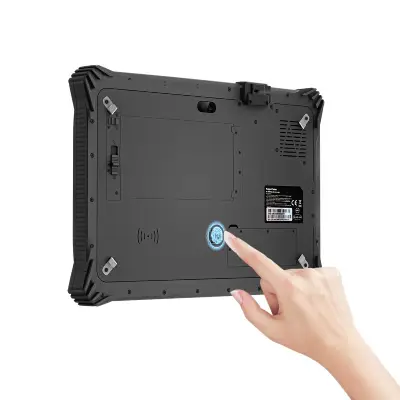
Neither philosophy is inherently better. They simply solve different problems. One emphasizes uniformity and scale. The other emphasizes flexibility and alignment. Recognizing these design differences allows you to step back, assess your real needs, and determine which approach fits your operation—not just which brand feels familiar.
Rugged Tablet Customization: A Key Difference Buyers Should Understand
Rugged Tablet Customization: A Key Difference Buyers Should Understand
Customization is often the dividing line between a device that works and a device that truly fits. In industrial projects, a rugged tablet is rarely used straight out of the box. Workflows differ. Environments vary. Hardware must adapt to the job, not the other way around.
Rugged tablet customization means more than choosing memory or storage. It includes selecting specific processors, adding 4G or 5G modules, NFC, fingerprint readers, or barcode scanners, and adjusting I/O ports for legacy equipment. It can also involve custom button functions, interface layouts, system permissions, and even branded logos or packaging. These details matter when devices are deployed at scale or integrated into existing systems. Please contact us to get custom rugged tablet solution for your project.

Not every manufacturer is built for this level of flexibility. Standardized platforms are efficient, but they leave little room for change once a configuration is fixed. SINSMART approaches rugged tablets from an industrial manufacturing perspective. Its products are designed to be adapted, modified, and aligned with project requirements from the start. For buyers facing complex environments, this capability often becomes the deciding factor.
From Rugged Tablet to Rugged Laptop: Thinking Long-Term with the Right Manufacturer
Most industrial projects do not stand still. What begins with a rugged tablet often grows into something larger. Teams add more applications. Workflows expand. New environments appear. Over time, the original requirement changes, and so does the hardware strategy.
This is where long-term thinking matters. Many buyers start with a single device type, then move toward rugged laptops, portable workstations, or mixed deployments. At that stage, the question is no longer about one product. It becomes about the manufacturer behind it. Can the same supplier support different form factors? Can they maintain consistency across platforms? Can they scale as projects evolve?
Well-known options such as a Dell Rugged Tablet may cover the first step. But long-term projects often demand a broader rugged portfolio and a partner mindset. SINSMART is built around this progression. Its range extends beyond tablets to rugged laptops and industrial portable systems, designed to work together over time. For buyers planning beyond the first purchase, choosing a manufacturer with this depth can simplify expansion, reduce integration effort, and support a lasting partnership rather than a one-time transaction.
If a project later requires higher computing performance, larger displays, or keyboard-based operation, buyers can also compare SINSMART’s industrial rugged laptops as part of a long-term rugged computing strategy. For field command, UAV control, vehicle diagnostics, or multi-screen industrial applications, SINSMART also provides industrial portable computers for projects that go beyond rugged tablet deployment.
Buying Guide: How to Evaluate Dell Rugged Tablet and SINSMART
When you reach the evaluation stage, your goal should be clarity—not brand preference. To compare Dell Rugged Tablet solutions and SINSMART fairly, you need a structured way to judge fit. This means stepping back from names and focusing on how each manufacturer supports your project from start to deployment and beyond.
You should begin by assessing scope. Are you buying a small batch or planning a multi-year rollout? Next, look at flexibility. Can hardware, interfaces, or modules be adjusted if requirements change? Then consider lifecycle factors such as supply continuity, repair strategy, and long-term availability. Support capability matters as well. Ask who handles engineering feedback, customization requests, and post-deployment issues. Finally, evaluate integration. The right manufacturer should fit smoothly into your existing systems, not force redesigns.
Use the checklist below to keep the comparison objective and balanced. It helps you evaluate both manufacturers on equal ground, without exclusion or bias.
| Evaluation Area | What You Should Check |
| Deployment Scale | Small batch vs large project |
| Customization | Hardware, I/O, modules, OS |
| Lifecycle Support | Long-term supply, repair model |
| Engineering Access | Pre-sales and post-sales support |
| System Integration | Compatibility with existing workflows |
Learn more details about how to choose rugged tablets, please read ultimate guide to rugged tablets.
Rugged Tablet Comparison: How You Should Read the Specs—Not the Brand
Rugged Tablet Comparison: How You Should Read the Specs—Not the Brand
When you reach the rugged tablet comparison stage, your goal is clarity, not persuasion. You are not choosing a name. You are checking whether a model matches your deployment reality. Popular models such as Latitude 7030, 7230, 7220, and the newer Pro Rugged series represent a standardized design approach. SINSMART’s 8-inch to 14-inch Android and Windows tablets reflect a manufacturing-driven, configurable model. Both are rugged. The difference lies in how well each fits your project.
Instead of comparing model to model, you should compare capabilities to requirements.
| Comparison Dimension | Dell Rugged Tablet | SINSMART Rugged Tablet |
| Product Positioning | Standardized enterprise-grade rugged tablets | Industrial-grade rugged tablets with customization focus |
| Screen Size Options | 10.1″ / 12″ | 8″ / 10.1″ / 12'' /14'' |
| Processor Platform | Intel® Core™ i5 / i7 / Core™ Ultra | ARM Octa-core / Intel® i5 / i7 |
| Operating System | Windows 10 / Windows 11 | Windows or Android or Linux |
| Display Brightness | 1000–1200 nits (sunlight readable) | 700–1000 nits (optional) |
| Rugged Rating | IP65 + MIL-STD-810H | IP65 / IP67 / IP68 + MIL-STD-810H + MIL-STD-461G |
| Battery Design | Removable / hot-swappable (model-dependent) | Large-capacity battery / Removable / hot-swappable |
| Wireless Connectivity | Wi-Fi 6E / Bluetooth / optional LTE / 5G | Wi-Fi / Bluetooth / 4G / 5G / optional LTE |
| Positioning & GNSS | GPS (enterprise-grade modules) | GPS / BeiDou / multi-mode optional |
| I/O & Expansion | Thunderbolt / docking solutions | Customizable |
| Functional Modules | Barcode scanner / NFC (optional) | Barcode scanner / NFC / Fingerprint / RFID |
| Branding & Appearance | Fixed brand and enclosure | Custom housing, logo, and labeling supported |
| Delivery Model | Standard models, bulk procurement | OEM, project-based delivery |
| Typical Customers | Multinational enterprises, standardized IT deployments | Industrial projects, vertical industries, government programs |
Recommended SINSMART Rugged Tablet Options by Application
Recommended SINSMART Rugged Tablet Options by Application
There are hot-selling SINSMART rugged tablets.
| Model | SIN-I1012E | SIN-I0801E-N100 | SIN-I1001E-N150 | SIN-Q0801E-Q1001E-670 | SIN-I1012E(Linux) |
| Size | 10.1 inch | 8-inch | 10.1 inch | 10.1-inch | 10.1 Inch Linux |
| CPU | i5-1235U Optional: i7-1255U | Intel Alder LAKE N100 | Intel Twin Lake N150 | Octa-core | i5-1235U |
| RAM | 16GB DDR4L | 8GB LPDDR5 | 8GB | 8GB | 16GB |
| ROM | 128GB SSD | 128GB EMMC | 128GB (optional: 256G/512G for mass customization) | 128GB | 128GB |
| Operating System | Windows 11 Pro (Home, IOT) Optional: Windows 10 IOT / Windows 10 Pro / Windows 10 Home | Windows 11 Home | windows 11 home | Android 14/GMS | Ubuntu22.04.4 |
| Display | LCD 10.1 inch 16:10 Resolution: 1200*1920 700cd/㎡ | IPS 8 inch 16:10 Resolution: 1200*1920 550cd/㎡ | TFT 10.1 inch 16:10 Resolution: 1200*1920 700cd/m² | FHD 10.1 inch 16:10 Resolution: 1200*1920 1000cd/㎡ | 10.1 inch LCD 16:10, resolution: 1200*1920, 700 Nit |
| wifi | Support | Support | Support | Support | Support |
| BLUETOOTH | Support | Support | Support | Support | Support |
| 4G | Support | Support | Support | Support | Support |
| 5G | - | - | Support | Support | - |
| GPS | GPS, Beidou, glonass | GPS, Glonass;Optional: GPS + BeiDou | GPS, Glonass | GPS/GLONASS/BDS | GPS, Glonass, Optional Beidou |
| Barcode Scanner(1D) | - | - | Optional | - | Optional |
| 2D(1D+2D) | - | - | Optional | - | Optional |
| NFC | Optional | - | Optional | Optional | - |
| Fingerprint | Optional | - | Optional | Optional | - |
For Android-based deployments, buyers can also read The Best Rugged Android Tablets of 2025 to compare Android rugged tablet use cases. For Windows-based field work, Best Rugged Windows Tablets for the Outdoors provides additional selection guidance.
Why Choose SINSMART Rugged Tablets?
Why Choose SINSMART Rugged Tablets?
-
Manufacturing-Driven Quality Control Every device follows a traceable process, from component sourcing to multi-stage reliability testing. This ensures consistent performance in harsh environments.
-
Proven Rugged Standards Products are designed to meet IP-rated protection, military-grade testing, and wide-temperature operation for demanding field conditions.
-
Deep Customization Capability Hardware interfaces, wireless modules, system functions, and branding can be adapted to match specific workflows and industry requirements.
-
Long-Term Project Support Designed for lifecycle stability, batch deployment, and future expansion into rugged laptops or portable workstations.
Conclusion
Conclusion
There is no single “best” option for every scenario. The best choice is the one that fits your environment, workflow, and budget. When you understand how different manufacturers design, build, and support rugged devices, you can make a smarter and more confident decision.
If you are planning to purchase rugged tablets for industrial, field, or government use, our team is ready to help. Contact us to discuss your application, request specifications, or explore customized solutions. We will help you find the right rugged tablet that truly works for your project.
FAQs
FAQs
FAQs
Q1. Is a Dell rugged tablet the only reliable option for industrial use?
A1. No. While a dell rugged tablet is often used as a reference point, many industrial projects require flexibility, customization, or specific interfaces that standardized products may not offer. That is why buyers increasingly evaluate alternative rugged manufacturers alongside Dell.
Q2. What types of projects usually consider SINSMART as an alternative?
A2. SINSMART is commonly considered in project-based deployments, such as manufacturing lines, logistics systems, public safety programs, and government tenders, where hardware configuration and long-term supply consistency are critical.
Q3. Are SINSMART rugged tablets built to the same durability standards?
A3. Yes. SINSMART devices are designed for harsh environments and follow recognized rugged standards, including protection against dust, water, vibration, and extreme temperatures, making them suitable for industrial and outdoor use.
Q4. Can SINSMART run the same software used on Dell rugged tablets?
A4. In most cases, yes. SINSMART offers Windows platforms that support common industrial applications, management tools, and custom software environments used in enterprise deployments. Even support android and Linux platforms.
Q5. Why do some buyers move away from a standardized rugged tablet?
A5. As deployments scale, buyers often need custom I/O, specialized modules, or workflow-specific configurations. Standardized models can limit these adjustments, prompting teams to explore manufacturers that support deeper hardware customization.
Q6. How important is customization in rugged tablet procurement?
A6. Customization becomes essential when devices must integrate with legacy equipment, scanners, sensors, or industry-specific systems. It reduces operational friction and lowers long-term integration costs.


LET'S TALK ABOUT YOUR PROJECTS
- sinsmarttech@gmail.com
-
3F, Block A, Future Research & Innovation Park, Yuhang District, Hangzhou, Zhejiang, China
Our experts will solve them in no time.