
 Rackmount PC
 Embedded Computing
 Industrial Portable Computers
 Rugged Tablets
 Rugged Laptop
 Industrial Panel PC
 Rugged Handheld
 Advantech Industrial PC
What Are the Components of an Industrial Computer?
Table of Contents
- 1. Central Processing Unit
- 2. Storage
- 3. Hard disk drive
- 4. Expansion slots
- 5. Input and output interfaces
- 6. Power Supply
- 7. Operating System
- 8. Conclusion
Industrial computers are essential control and data processing platforms in modern automation. Understanding the structure of an industrial computer is one of the best ways to understand how it works, why it remains stable in demanding environments, and how it supports different industrial tasks.Before looking at the parts themselves, it is important to understand what an industrial computer actually is. An industrial computer is a computer designed for industrial environments and industrial workloads. Compared with ordinary office computers, it is typically built for higher reliability, better stability, stronger environmental adaptability, and easier integration with industrial control, monitoring, and data-processing tasks.This is why industrial computers are widely used in manufacturing, transportation, energy, communication, machine vision, automation, and other industrial fields. They are not just general-purpose computers placed in factories. They are computing platforms selected to match industrial requirements such as continuous operation, real-time response, interface expansion, and long-term stability.This article explains the main components of an industrial computer and gives a clearer view of how those parts work together in practical industrial applications.
1. Central Processing Unit
The central processing unit (CPU) is the core component of industrial computers. It is responsible for executing instructions and processing data and includes the arithmetic logic unit (ALU), the control unit (CU), and registers. The CPU's performance and processing power play a crucial role in the overall performance of industrial computers.When choosing an industrial computer, the CPU should not be judged only by raw specification. It should also be matched with the actual workload, such as automation control, machine vision, edge analysis, monitoring, or industrial communication. A suitable CPU choice helps avoid both underperformance and unnecessary overconfiguration.

2. Storage
Random Access Memory (RAM) is a temporary storage device used by industrial computers to store data and programs, allowing the CPU to quickly access data and instructions. RAM is divided into main memory and cache memory. Common main memory types are Random Access Memory (RAM) and Read-Only Memory (ROM).Cache memory also plays a role in improving data access efficiency, while main memory supports daily program execution. In practical terms, memory affects how smoothly an industrial computer can handle industrial software, visualization tools, and continuous data processing.
3. Hard disk drive
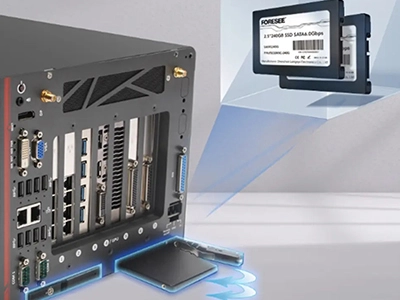
Hard disk drives are devices for long-term storage and retrieval of data. Industrial computers typically use solid-state drives (SSDs) or mechanical hard disk drives (HDDs). They offer ample storage space for operating systems, applications, configuration files, and data.In many industrial projects, SSDs are preferred because they usually provide faster data access, faster boot speed, and better resistance to shock compared with mechanical drives. However, HDDs may still be considered where larger storage capacity is required at lower cost.Storage selection should be matched with the actual use case. For example, systems handling image data, logs, local databases, or long-term process records may require larger and more durable storage solutions.
4. Expansion slots
Expansion slots are interfaces for connecting and installing various expansion cards. Expansion slots can increase the functionality and performance of industrial computers, for example, through the use of graphics cards, network interface cards, data acquisition cards, etc. Common expansion slot types include PCI, PCIe, etc.This is one of the major differences between many industrial computers and ordinary consumer computers. In industrial projects, the ability to expand a system is often critical because project needs may include extra network ports, fieldbus cards, GPU support, machine vision cards, or customized control modules.A computer with suitable expansion capacity is easier to adapt to changing project requirements and may reduce the need for complete hardware replacement later.
5. Input and output interfaces
Input and output interfaces allow an industrial computer to exchange data and communicate with external devices. These interfaces are essential for practical deployment because industrial computing rarely happens in isolation.Common input interfaces include keyboards, mice, touchscreens, scanners, sensors, and acquisition modules. Common output interfaces include monitors, printers, audio outputs, and network interfaces. Industrial computers may also provide serial ports, USB ports, HDMI, LAN ports, GPIO, and other industrial communication interfaces.These interfaces allow industrial PCs to interact effectively with operators, controllers, sensors, displays, and surrounding systems.In many industrial applications, interface selection is one of the most important purchase factors. A computer may need to connect to PLCs, industrial cameras, inspection tools, barcode readers, displays, network equipment, or other control hardware. If the interface layout does not match the deployment requirement, even a powerful CPU platform may not be the right choice.

6. Power Supply
The power supply unit provides the electrical power required for the industrial computer to operate. In industrial environments, the quality of power delivery is especially important because voltage instability, electrical noise, and interference may affect system reliability.Industrial computers typically require a stable and reliable power supply to help them adapt to industrial power conditions and long operating cycles.A dependable power supply does more than simply turn the computer on. It helps support stable operation, reduces the risk of abnormal shutdowns, and improves system reliability in environments where voltage fluctuations or electromagnetic interference may exist.
7. Operating System
The operating system is the core software platform of the industrial computer. It manages hardware resources and supports the execution of software applications.Common operating systems for industrial computers include embedded Windows systems, Linux, and real-time operating systems.
- Different industrial projects may require different operating systems. Windows is widely used in industrial applications because it offers broad software compatibility, a familiar user interface, and support for monitoring, control, human-machine interface, data acquisition, and processing tasks.
- Linux is also widely used in industrial computing because it is open source, stable, flexible, and well suited to applications that require customization and reliability. It is common in embedded systems, industrial automation, and network-related platforms.
Some industrial applications may also use Kylin or customized operating systems, especially where localization, security requirements, or project-specific software environments are important.This means the operating system should not be treated as an isolated software choice. It should be selected together with hardware, interfaces, application requirements, and project deployment goals.

8. Conclusion
The components of an industrial computer together form a stable and practical computing platform for industrial automation and industrial data processing. A deeper understanding of these components helps users better understand how industrial computers function and why they are suitable for demanding environments.At the same time, the parts of an industrial computer should not be viewed only as a simple hardware checklist. They reflect the broader requirements of industrial computing: reliability, real-time response, scalability, maintenance convenience, and deployment adaptability.When evaluating an industrial computer, buyers should look beyond the specification list and consider how each component supports the real application environment. That is the key to choosing a platform that is not only powerful on paper, but also effective in long-term industrial use.
Learn more about our products:
Industrial Rackmount PC
1U Rack-Mount Computer
Mini Embedded PC
2U Rack Mount Computer
Military Laptop for Sale


LET'S TALK ABOUT YOUR PROJECTS
- sinsmarttech@gmail.com
-
3F, Block A, Future Research & Innovation Park, Yuhang District, Hangzhou, Zhejiang, China
Our experts will solve them in no time.