
 Rackmount PC
 Embedded Computing
 Industrial Portable Computers
 Rugged Tablets
 Rugged Laptop
 Industrial Panel PC
 Rugged Handheld
 Advantech Industrial PC
Blog
MIL-STD-810 Rugged Standard Explained: What It Means for Industrial Tablets and Laptops
2026-07-29
Table of Contents
- I. Introduction
- II. What MIL-STD-810 Means—and What It Does Not
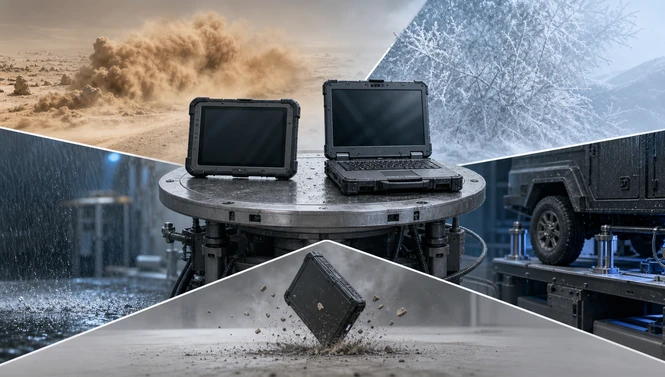
- III. Which Environmental Tests Matter for a Rugged Tablet or Rugged Laptop?
- IV. How to Read MIL-STD-810 Claims Without Being Misled
- V. What MIL-STD-810 Means for a Rugged Tablet
- VI. What MIL-STD-810 Means for a Rugged Laptop
- VII.Rugged Tablet vs Rugged Laptop: Choose by Workflow
- VIII. How to Verify MIL-STD-810 Evidence Before a Volume Order
- IX. Turning the Standard Into a Better SINSMART Configuration
- X. FAQ
Introduction
Introduction
A rugged tablet or rugged laptop may carry a MIL-STD-810 claim, but that label alone does not tell you how durable the device is. The practical value depends on which test methods were used, the severity of each procedure, whether the device operated during exposure, and whether the conditions match your jobsite.
That distinction matters as organizations standardize larger mobile-device fleets. IDC reported on February 24, 2026 that worldwide tablet shipments grew 5% in 2025 to 151.9 million units, with education and government projects contributing to institutional demand (IDC, February 24, 2026). For industrial buyers, a small specification mistake multiplied across a fleet can become repeated downtime, repairs, and redeployment work.
The short answer is this: MIL-STD-810 is a U.S. Department of Defense test-method standard for evaluating environmental stresses across a product’s service life. It is not a single design specification, and a claim does not mean a device passed every method. The official DLA record describes an environmental-tailoring process rather than universal design or test limits (DLA ASSIST Quick Search).
What MIL-STD-810 Means—and What It Does Not
What MIL-STD-810 Means—and What It Does Not
MIL-STD-810 is titled *Environmental Engineering Considerations and Laboratory Tests*. The active DLA record is dated May 18, 2022 and identifies the document as an active test-method standard.
Three points shape every buying decision:
-
Testing is tailored. The expected transport, storage, operation, climate, and handling conditions determine which methods and severities are relevant.
-
Not every method applies to every product. A warehouse rugged tablet and a coastal field rugged laptop face different risks.
-
A general claim is incomplete evidence. Buyers need the revision, method, procedure, parameters, operating state, and result.
“MIL-STD-810H tested” should therefore begin a technical conversation, not end it. It does not automatically mean “military approved,” “indestructible,” suitable for combat, or covered against accidental damage under warranty.
MIL-STD-810G vs MIL-STD-810H
MIL-STD-810H is newer than MIL-STD-810G, but the revision letter is not a durability score. A well-documented 810G test that closely matches your environment may be more decision-useful than a vague 810H badge.
Ask which revision and change notice were used, then examine the actual procedure. For current tenders, use 810H language when it reflects the project requirement, but do not discard method-level evidence from a long-lifecycle product simply because its report references 810G.
Which Environmental Tests Matter for a Rugged Tablet or Rugged Laptop?
Which Environmental Tests Matter for a Rugged Tablet or Rugged Laptop?
The useful test set follows the failure risks in your deployment.
|
Environmental area
|
What it helps evaluate
|
Common industrial exposure
|
|
High and low temperature
|
Startup, operation, storage, materials, battery behavior
|
Cold storage, deserts, unconditioned vehicles
|
|
Temperature shock
|
Rapid transitions and condensation-related stress
|
Moving between outdoors and heated facilities
|
|
Vibration
|
Fasteners, connectors, storage, boards, display mounts
|
Forklifts, trucks, rail, heavy machinery
|
|
Mechanical shock and drop
|
Sudden impact and handling damage
|
Field service, warehouses, public safety
|
|
Rain and humidity
|
Water exposure, condensation, corrosion
|
Utilities, construction, ports
|
|
Sand and dust
|
Seals, vents, fans, keyboards, connectors
|
Mining, agriculture, manufacturing
|
|
Low pressure / altitude
|
Operation or transport at reduced pressure
|
Aviation, high-altitude fieldwork
|
|
Salt fog
|
Corrosion susceptibility
|
Marine, coastal, road-salt environments
|
The phrase “drop tested” is still incomplete. A defensible report should state the drop height, surface, number of drops, orientations, device configuration, and whether it was operating. Vibration evidence should identify the profile, axes, duration, mounting, and functional checks.
Temperature claims also need careful wording. “Storage at −30°C” does not prove that the screen, battery, touch layer, wireless connection, and processor operate at −30°C. For a rugged laptop or rugged tablet used during exposure, request powered-operation evidence.
Sequence can matter as much as a single exposure. A rugged tablet carried from a cold vehicle into a humid plant may experience rapid temperature change and condensation before it is dropped or mounted on vibrating equipment. A rugged laptop used for vehicle diagnostics may be hot, powered, and connected to several cables when vibration begins. Testing every stress in isolation can miss interactions that occur during a real shift. Ask whether the environmental profile reflects transport, storage, startup, continuous operation, and transition between locations. For high-risk projects, use the laboratory report to design a pilot sequence that repeats the actual order of events rather than creating an unrelated collection of extreme tests.
How to Read MIL-STD-810 Claims Without Being Misled
How to Read MIL-STD-810 Claims Without Being Misled
How to Read MIL-STD-810 Claims Without Being Misled
Use a three-layer interpretation:
Layer 1: The standard reference
Confirm the revision: 810G, 810G Change 1, 810H, or 810H Change 1. Confirm that the report is for the exact model and configuration you plan to buy.
Layer 2: The method and procedure
The method identifies the environmental stress. The procedure and tailored parameters define what actually happened. Record temperature, time, humidity, vibration spectrum, shock pulse, drop surface, and other limits.
Layer 3: The result and acceptance criteria
“Passed” must have a defined meaning. Did the device boot afterward? Did it operate continuously? Were ports, touch, display, battery, camera, wireless links, and storage checked? Were cosmetic defects allowed?
This is also why MIL-STD-810 and an IP rating are complementary:
|
Reference
|
Main question
|
|
MIL-STD-810
|
How does the device respond to selected, tailored environmental stresses?
|
|
IEC 60529 IP rating
|
How well does the enclosure resist specified dust and water ingress?
|
|
MIL-STD-461
|
How does equipment control electromagnetic emissions and susceptibility?
|
An IP65 or IP68 result should not be substituted for vibration or temperature evidence. Likewise, MIL-STD-810 rain or dust procedures do not automatically establish a particular IP code.

What MIL-STD-810 Means for a Rugged Tablet
What MIL-STD-810 Means for a Rugged Tablet
What MIL-STD-810 Means for a Rugged Tablet
What MIL-STD-810 Means for a Rugged Tablet
A rugged tablet is normally selected for handheld mobility, data capture, vehicle mounting, maps, inspection forms, and wireless communication. Its risk profile emphasizes:
-
Repeated handling and multi-face drops
-
Wet-hand or glove interaction
-
Rain, dust, and exposed charging or data ports
-
Forklift or vehicle vibration
-
Sunlight readability
-
Battery endurance and charging strategy
-
Mount and docking retention
For example, the SIN-T0802E-8781 8.68-inch rugged tablet publishes IP68 and MIL-STD-810H, a powered-on 1.22 m drop condition onto composite wood, and −20°C to 60°C working temperature. Those details are more useful than the standard name alone because they expose actual selection parameters.
For a larger Android option, the SIN-T1101E-8781 10.95-inch rugged tablet combines a larger display with IP68 and MIL-STD-810H listings. Buyers should still request the underlying procedures that matter to the deployment.
Review the broader SINSMART rugged tablet range when operating system, screen size, scanner, NFC, GNSS, cellular bands, dock, or vehicle mount is the primary differentiator.
What MIL-STD-810 Means for a Rugged Laptop
What MIL-STD-810 Means for a Rugged Laptop
A rugged laptop serves workflows that need a physical keyboard, larger screen, Windows applications, native industrial I/O, storage expansion, or long diagnostic sessions. Its additional exposure points include hinges, keyboard sealing, port covers, cable loads, cooling, and battery exchange.
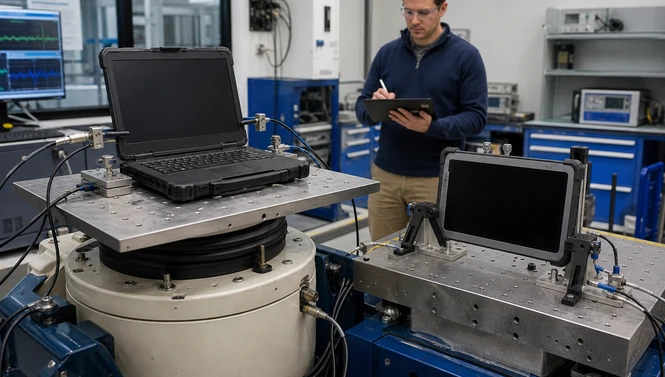
Vehicle diagnostics and equipment commissioning make vibration evidence especially important. A rugged laptop may remain open, powered, connected to serial or LAN equipment, and exposed to repeated motion. The test configuration should therefore resemble the deployed state.
The SIN-S1412E/SIN-S1512E rugged laptop family offers 14-inch and 15.6-inch formats with 12th-generation Intel Core options, Windows 10/11, high-brightness displays, and industrial connectivity. The current fully rugged laptop category also compares protection, battery design, and I/O across multiple models.
Do not select a rugged notebook by processor alone. Confirm:
-
The screen is readable at the actual viewing angle and lighting.
-
Required RS232, LAN, USB, CAN, or other interfaces are native or securely docked.
-
The battery can cover the shift or be exchanged without stopping critical work.
-
Cooling remains stable at the specified operating temperature.
-
The test report covers the purchased storage, battery, display, and radio configuration.
Rugged Tablet vs Rugged Laptop: Choose by Workflow
Rugged Tablet vs Rugged Laptop: Choose by Workflow
Rugged Tablet vs Rugged Laptop: Choose by Workflow
|
Decision factor
|
Rugged tablet
|
Rugged laptop
|
|
Primary interaction
|
Touch, stylus, scanning, camera
|
Keyboard, touchpad, complex desktop software
|
|
Mobility
|
Better for walking and one-hand tasks
|
Better for stationary or cart-based sessions
|
|
Typical risk
|
Drops, rain, mounts, touch usability
|
Vibration, hinges, ports, cable strain, thermal load
|
|
Data capture
|
Integrated camera, barcode, NFC options
|
External tools and native industrial interfaces
|
|
Display/workspace
|
Compact and quick
|
Larger workspace for diagnostics, CAD, reports
|
|
Power strategy
|
Dock, vehicle charging, removable battery
|
Larger or dual batteries, hot-swap options
|
Choose a rugged tablet when the worker moves continuously, captures data at the point of work, and needs a sealed lightweight device. Choose a rugged laptop when the task requires sustained typing, multi-window software, rich wired I/O, or higher local compute.
A detachable keyboard does not automatically turn a tablet into a laptop replacement. Test the complete assembly—including mount, keyboard, dock, charger, and cables—under the actual workflow.
Ergonomics should also be part of the pilot. A rugged tablet that meets the environmental requirement may still be too heavy for repeated one-hand scanning, while a rugged laptop that survives vibration may take too long to deploy in a cramped service vehicle. Measure task completion time, carrying comfort, screen visibility, glove use, cable management, and battery changes. The best rugged tablet is the one operators can use safely and consistently; the best rugged laptop is the one that supports the required software and interfaces without creating new handling problems.
How to Verify MIL-STD-810 Evidence Before a Volume Order
How to Verify MIL-STD-810 Evidence Before a Volume Order
How to Verify MIL-STD-810 Evidence Before a Volume Order
Request a test evidence pack with:
-
Exact model, hardware revision, and tested configuration
-
MIL-STD-810 revision and change notice
-
Method and procedure numbers
-
Tailored severity parameters and duration
-
Operating, non-operating, or storage state
-
Sample quantity and preconditioning
-
Mounting, accessories, port covers, and battery state
-
Pass/fail criteria and functional checks
-
Laboratory identity and report date
-
Deviations, damage, repairs, or retests
Then build a requirement-to-evidence matrix. Mark each environmental risk as verified, partially verified, not stated, or not applicable. Do not convert “not stated” into “passed.”
Finally, run a pilot with production software, network policies, gloves, mounts, peripherals, chargers, and real shift patterns. Laboratory evidence reduces uncertainty; it does not replace deployment validation.
Turning the Standard Into a Better SINSMART Configuration
Turning the Standard Into a Better SINSMART Configuration
Turning the Standard Into a Better SINSMART Configuration
Start with the environment, not a model number. Provide SINSMART with:
-
Minimum and maximum operating temperatures
-
Rain, dust, humidity, salt, altitude, and chemical exposure
-
Drop height, likely surface, and handling frequency
-
Vehicle or machine vibration conditions
-
Software, operating system, security, and image requirements
-
Required ports, scanners, NFC, GNSS, 4G/5G, Wi-Fi, and docks
-
Shift length, charging access, and battery-exchange plan
-
Order volume, lifecycle, spare-unit, and accessory needs
The selection team can then compare the appropriate rugged tablet or rugged laptop, identify which environmental evidence is available, and define any project-specific verification. For additional tablet selection context, see SINSMART’s guide to choosing the most rugged tablet.
Planning a harsh-environment deployment? Send SINSMART your environmental profile, software stack, I/O list, mounting plan, and quantity. Request a method-level evidence review and a pilot configuration before volume purchasing.

FAQ
FAQ
FAQ
Q1: What does MIL-STD-810H mean on a rugged tablet?
It means the rugged tablet is claimed to have been evaluated using selected methods from the 810H revision. Ask for the exact methods, procedures, severity, operating state, and results; the label does not prove every test was performed.
Q2: Is a MIL-STD-810 rugged laptop military approved?
Not necessarily. MIL-STD-810 is a DoD test-method standard, but a commercial product claim does not automatically mean the U.S. military tested, approved, or purchased the rugged laptop.
Q3: What is the difference between MIL-STD-810G and 810H?
810H is the newer revision. The practical difference for purchasing depends on the selected method, procedure, severity, and documentation—not simply whether the letter is G or H.
Q4: Does MIL-STD-810H mean a device is waterproof?
No. Selected rain or immersion procedures may provide relevant evidence, but an IEC 60529 IP rating is the clearer enclosure-ingress reference. Check both claims separately.
Q5: Is IP68 better than MIL-STD-810H?
They are not competing scores. IP68 addresses defined dust and water ingress conditions; MIL-STD-810 addresses selected environmental stresses such as vibration, shock, and temperature.
Q6: Which MIL-STD-810 tests matter most for vehicle use?
Vibration, mechanical shock, temperature, humidity, and sometimes dust are common priorities. Test the device with its real mount, power supply, cables, and operating configuration.
Q7: Should I choose a rugged tablet or rugged laptop for field service?
Choose a rugged tablet for mobile forms, photos, scanning, and one-hand work. Choose a rugged laptop for extensive typing, desktop applications, diagnostics, and native wired interfaces.
Q8: What should I request before ordering rugged computers in volume?
Request the exact test report, method/procedure matrix, tested configuration, current product specifications, accessory list, warranty terms, lifecycle plan, and a pilot unit for workflow validation.


LET'S TALK ABOUT YOUR PROJECTS
- sinsmarttech@gmail.com
-
3F, Block A, Future Research & Innovation Park, Yuhang District, Hangzhou, Zhejiang, China
Our experts will solve them in no time.